About the Phase 3 Clinical Trial for Tourette Syndrome

Emalex is conducting a Phase 3 clinical trial to evaluate the safety and efficacy of ecopipam (EBS-101) in children, adolescents and adults with Tourette’s Disorder (TD). This study is enrolling participants in North America and Europe and is regulated by the U.S. Food and Drug Administration (FDA) and by similar regulatory agencies outside the U.S.

Difficulties children experience with Tourette's Disorder

About the Phase 3 Clinical Trial for Tourette Syndrome

Emalex is conducting a Phase 3 clinical trial to evaluate the safety and efficacy of ecopipam (EBS-101) in children, adolescents and adults with Tourette’s Disorder (TD). This study is enrolling participants in North America and Europe and is regulated by the U.S. Food and Drug Administration (FDA) and by similar regulatory agencies outside the U.S.

Difficulties children experience with Tourette's Disorder

About the Phase 3 Clinical Trial for Tourette Syndrome

Emalex is conducting a Phase 3 clinical trial to evaluate the safety and efficacy of ecopipam (EBS-101) in children, adolescents and adults with Tourette’s Disorder (TD). This study is enrolling participants in North America and Europe and is regulated by the U.S. Food and Drug Administration (FDA) and by similar regulatory agencies outside the U.S.

Difficulties children experience with Tourette's Disorder
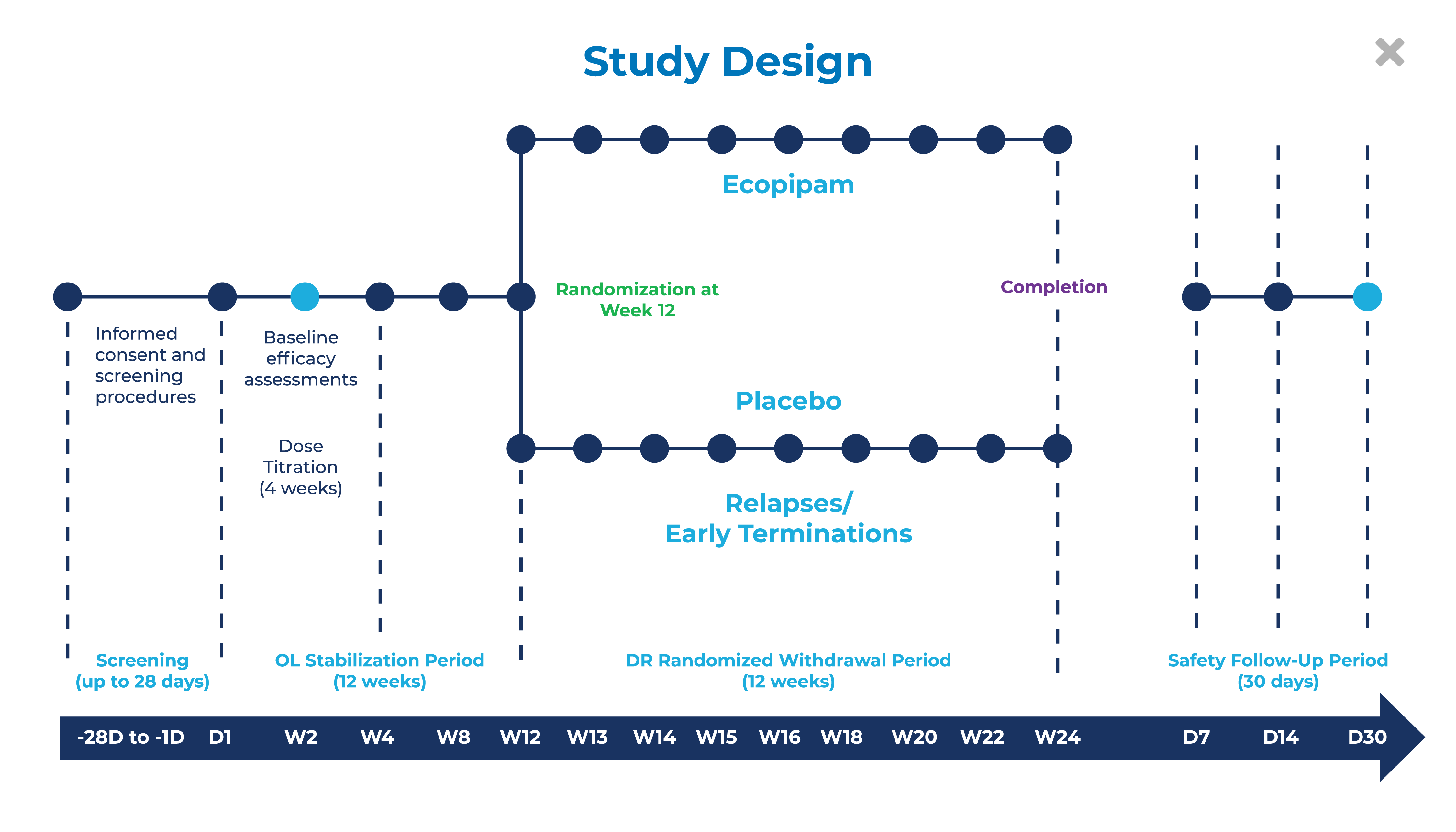
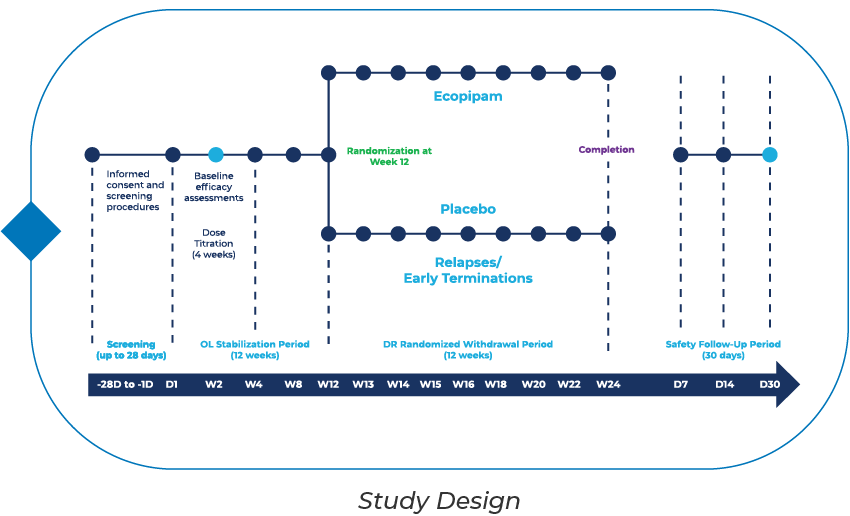
Tourette's Disorder Study Design Diagram

What Will the Study Involve?

  • Screening Period – up to 28 days
  • Open-Label Stabilization Period – comprised of a 4-week Titration Phase and 8-week Maintenance Phase.
  • Double-Blind Randomized Withdrawal Period – subjects who respond to study treatment will be randomized 1:1 to either placebo or ecopipam for up to 12 weeks; subjects that meet relapse criteria will be discontinued.
  • Safety Follow-Up Period – all subjects who enroll in the study will complete clinic visits at Days 7 and 14 after the last dose of study medication and a 30-day telephone follow up call.
  • Additional study details should be discussed with healthcare providers at designated study sites.
Tourette's Disorder Study Design Diagram

What Will the Study Involve?

  • Screening Period – up to 28 days
  • Open-Label Stabilization Period – comprised of a 4-week Titration Phase and 8-week Maintenance Phase.
  • Double-Blind Randomized Withdrawal Period – subjects who respond to study treatment will be randomized 1:1 to either placebo or ecopipam for up to 12 weeks; subjects that meet relapse criteria will be discontinued.
  • Safety Follow-Up Period – all subjects who enroll in the study will complete clinic visits at Days 7 and 14 after the last dose of study medication and a 30-day telephone follow up call.
  • Additional study details should be discussed with healthcare providers at designated study sites.
Tourette's Disorder Study Design Diagram

What Will the Study Involve?

  • Screening Period – up to 28 days
  • Open-Label Stabilization Period – comprised of a 4-week Titration Phase and 8-week Maintenance Phase.
  • Double-Blind Randomized Withdrawal Period – subjects who respond to study treatment will be randomized 1:1 to either placebo or ecopipam for up to 12 weeks; subjects that meet relapse criteria will be discontinued.
  • Safety Follow-Up Period – all subjects who enroll in the study will complete clinic visits at Days 7 and 14 after the last dose of study medication and a 30-day telephone follow up call.
  • Additional study details should be discussed with healthcare providers at designated study sites.

Find A Trial Location

Find A Trial Location

Find A Trial Location

Radius: Km
Loading...
Number Of Sites: 0 PRINT

Site Direction

GET DIRECTIONS

Use my location to find the closest Site near me

Description

Frequently Asked Questions

Frequently Asked Questions

Frequently Asked Questions

  • In a clinical study like this one, participants receive a study drug for the purpose of finding out if the study drug works for the condition and whether or not it has side effects.
  • In a clinical study like this one, participants receive a study drug for the purpose of finding out if the study drug works for the condition and whether or not it has side effects.
  • In a clinical study like this one, participants receive a study drug for the purpose of finding out if the study drug works for the condition and whether or not it has side effects.
  • A study drug is a substance that is being tested in clinical studies. The safety and efficacy of a study drug have not yet been established. The study is reviewed by an ethics committee before the study drug is tested in people. After the research study is completed, the study drug may or may not be approved by the government’s health agency for the treatment of the condition being studied.
  • A study drug is a substance that is being tested in clinical studies. The safety and efficacy of a study drug have not yet been established. The study is reviewed by an ethics committee before the study drug is tested in people. After the research study is completed, the study drug may or may not be approved by the government’s health agency for the treatment of the condition being studied.
  • A study drug is a substance that is being tested in clinical studies. The safety and efficacy of a study drug have not yet been established. The study is reviewed by an ethics committee before the study drug is tested in people. After the research study is completed, the study drug may or may not be approved by the government’s health agency for the treatment of the condition being studied.
  • Tourette’s Disorder affects millions of children, adolescents, and adults around the world, and there is a need for more research for this condition.
  • Pharmaceutical companies use clinical studies like this one to learn more about study drugs before they are made available to the public. Study participants can help us in this important research. Thank you for considering participation in this study.
  • Tourette’s Disorder affects millions of children, adolescents, and adults around the world, and there is a need for more research for this condition.
  • Pharmaceutical companies use clinical studies like this one to learn more about study drugs before they are made available to the public. Study participants can help us in this important research. Thank you for considering participation in this study.
  • Tourette’s Disorder affects millions of children, adolescents, and adults around the world, and there is a need for more research for this condition.
  • Pharmaceutical companies use clinical studies like this one to learn more about study drugs before they are made available to the public. Study participants can help us in this important research. Thank you for considering participation in this study.
  • Scientists are researching a study drug called ecopipam for adults, adolescents, and children with Tourette’s Disorder. Scientists want to find out how it works over time and how safe it is for adults, adolescents, and children with Tourette’s Disorder.
  • A study drug is one that is not approved for use by the general public for this condition.
  • Scientists are researching a study drug called ecopipam for adults, adolescents, and children with Tourette’s Disorder. Scientists want to find out how it works over time and how safe it is for adults, adolescents, and children with Tourette’s Disorder.
  • A study drug is one that is not approved for use by the general public for this condition.
  • Scientists are researching a study drug called ecopipam for adults, adolescents, and children with Tourette’s Disorder. Scientists want to find out how it works over time and how safe it is for adults, adolescents, and children with Tourette’s Disorder.
  • A study drug is one that is not approved for use by the general public for this condition.
  • This study is enrolling participants who:
    • Are at least 6 years of age
    • Weigh at least 18 kg (39.6 lbs)
    • Have been diagnosed with Tourette’s Disorder
    • Have both motor and vocal tics
  • This is not a complete list of study requirements. The study doctor will review the full study requirements with you.
  • This study is enrolling participants who:
    • Are at least 6 years of age
    • Weigh at least 18 kg (39.6 lbs)
    • Have been diagnosed with Tourette’s Disorder
    • Have both motor and vocal tics
  • This is not a complete list of study requirements. The study doctor will review the full study requirements with you.
  • This study is enrolling participants who:
    • Are at least 6 years of age
    • Weigh at least 18 kg (39.6 lbs)
    • Have been diagnosed with Tourette’s Disorder
    • Have both motor and vocal tics
  • This is not a complete list of study requirements. The study doctor will review the full study requirements with you.
  • Clinical studies (also called clinical trials) are important for medical advances. Current treatments for diseases have only become available because individuals agreed to participate in clinical trials. Participation in a clinical study is voluntary and should always be discussed with your healthcare provider.
  • Clinical studies (also called clinical trials) are important for medical advances. Current treatments for diseases have only become available because individuals agreed to participate in clinical trials. Participation in a clinical study is voluntary and should always be discussed with your healthcare provider.
  • Clinical studies (also called clinical trials) are important for medical advances. Current treatments for diseases have only become available because individuals agreed to participate in clinical trials. Participation in a clinical study is voluntary and should always be discussed with your healthcare provider.
  • In the Phase 3 D1AMOND study, there will be four study periods. First, there is a screening period, which will last up to 28 days. During the screening period, doctors will decide if individuals are eligible to participate in the study.
  • Next is the open-label stabilization period, which will last around 12 weeks. During this period, all participants will receive the study drug, ecopipam.
  • The double-blind randomized withdrawal period will follow. It will last about 12 weeks. During this period, some participants will receive the study drug, ecopipam, and some will receive a placebo. A placebo is a substance that looks like the study drug but has no study drug in it. Participants will be chosen at random (by chance, like flipping a coin) to receive the study drug or the placebo.
  • The final portion of the study is the safety follow-up period, which will last about 30 days.
  • Participants who complete the study will have the opportunity to enter an extension study where all participants will receive the
    study drug.
  • Lab tests, physical exams, and other assessments and questionnaires will be conducted as part of this study.
  • More detailed information regarding the study, including expectations, will be provided by the study doctor.
  • In the Phase 3 D1AMOND study, there will be four study periods. First, there is a screening period, which will last up to 28 days. During the screening period, doctors will decide if individuals are eligible to participate in the study.
  • Next is the open-label stabilization period, which will last around 12 weeks. During this period, all participants will receive the study drug, ecopipam.
  • The double-blind randomized withdrawal period will follow. It will last about 12 weeks. During this period, some participants will receive the study drug, ecopipam, and some will receive a placebo. A placebo is a substance that looks like the study drug but has no study drug in it. Participants will be chosen at random (by chance, like flipping a coin) to receive the study drug or the placebo.
  • The final portion of the study is the safety follow-up period, which will last about 30 days.
  • Participants who complete the study will have the opportunity to enter an extension study where all participants will receive the
    study drug.
  • Lab tests, physical exams, and other assessments and questionnaires will be conducted as part of this study.
  • More detailed information regarding the study, including expectations, will be provided by the study doctor.
  • In the Phase 3 D1AMOND study, there will be four study periods. First, there is a screening period, which will last up to 28 days. During the screening period, doctors will decide if individuals are eligible to participate in the study.
  • Next is the open-label stabilization period, which will last around 12 weeks. During this period, all participants will receive the study drug, ecopipam.
  • The double-blind randomized withdrawal period will follow. It will last about 12 weeks. During this period, some participants will receive the study drug, ecopipam, and some will receive a placebo. A placebo is a substance that looks like the study drug but has no study drug in it. Participants will be chosen at random (by chance, like flipping a coin) to receive the study drug or the placebo.
  • The final portion of the study is the safety follow-up period, which will last about 30 days.
  • Participants who complete the study will have the opportunity to enter an extension study where all participants will receive the
    study drug.
  • Lab tests, physical exams, and other assessments and questionnaires will be conducted as part of this study.
  • More detailed information regarding the study, including expectations, will be provided by the study doctor.
  • Participants will be in this study for approximately 8 months and will have up to 15 visits to the study site during that time. There will also be at least two telephone appointments during the study.
  • Participants will be in this study for approximately 8 months and will have up to 15 visits to the study site during that time. There will also be at least two telephone appointments during the study.
  • Participants will be in this study for approximately 8 months and will have up to 15 visits to the study site during that time. There will also be at least two telephone appointments during the study.
  • You do not have to pay for the study drug, supplies, or tests that are part of the clinical study.
  • You do not have to pay for the study drug, supplies, or tests that are part of the clinical study.
  • You do not have to pay for the study drug, supplies, or tests that are part of the clinical study.
  • There are risks involved with any clinical study, including this study. The research doctor will review the risks with you, and you will be closely monitored by the research staff throughout the study.
  • There are risks involved with any clinical study, including this study. The research doctor will review the risks with you, and you will be closely monitored by the research staff throughout the study.
  • There are risks involved with any clinical study, including this study. The research doctor will review the risks with you, and you will be closely monitored by the research staff throughout the study.

Additional Resources

Additional Resources

Additional Resources